

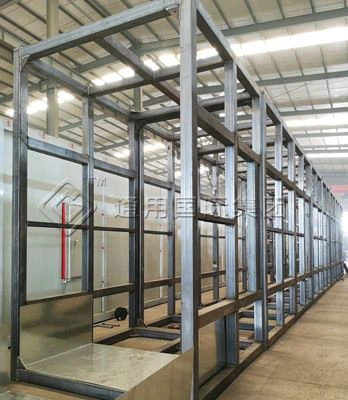
What is Egg Tray Dryer?
After forming, egg trays still contain high moisture content, which must be removed to ensure product strength and durability. A metal egg tray drying machine is a type of industrial-grade oven specifically designed to remove moisture from wet pulp molding products.
As a critical step in the egg tray production line, this equipment uses controlled thermal evaporation to turn wet, fragile egg trays into durable, market-ready packaging.
This process enhances the overall quality of the final product, making it more competitive in the market. In addition to egg tray dryers, our production line offers various other types of egg tray processing equipment.
How to Choose the Right Egg Tray Drying Machine?
1. Single-Layer Metal Drying Line
The AGICO single-layer metal drying line features a metal structure where egg trays move horizontally through the drying area on a single-layer conveyor.
Working Principle
A hot air circulation system evenly heats the trays on the conveyor.
The trays complete the entire drying process on a single horizontal level.
Typically equipped with a temperature control system that allows for zone-specific temperature adjustments.
Key Features
| Feature | Description |
|---|---|
| Automation Level | Fully automatic with belt conveyor, easy to operate, reduces labor. |
| Drying Time | 17–18 minutes |
| Temperature Range | 80–210°C (zone temperature control) |
| Energy Efficiency | Approximately 40% energy savings compared to traditional equipment. |
| Space Footprint | Horizontally arranged, requires a larger floor area. |
| Appearance | Steel structure, aesthetically pleasing and durable; suitable for regions with high environmental standards. |
| Suitable Scenarios | Fully automatic egg tray production lines; supporting large-scale egg tray machines; clients with high standards for equipment appearance and environmental compliance; users with long-term investment plans. |

2. Multi-Layer Metal Drying Line
The AGICO multi-layer metal drying line is currently the most widely used metal drying equipment. It employs a vertical multi-layer structure, achieving higher drying capacity within a limited footprint.
Working Principle
Features a 6-layer vertical design with hot air circulation.
Trays move cyclically between multiple layers of conveyor belts, making efficient use of vertical space.
Hot air circulates evenly between layers, ensuring consistent heating for trays on each level.
Key Features
| Feature | Description |
|---|---|
| Automation Level | Fully automatic with PLC control and belt conveyor. |
| Drying Time | 12 minutes |
| Temperature Range | 80–210°C (zone temperature control) |
| Space Footprint | Compact design, small footprint (vertical multi-layer layout). |
| Advantage | High space utilization-this is the greatest advantage of the multi-layer metal drying line. |
| Suitable Scenarios | Fully automatic egg tray production lines; customers with limited floor space but high capacity requirements; supporting large-scale egg tray machines; users with long-term investment plans. |

3. Brick Kiln Drying Line
The brick kiln drying line is a semi-automatic drying system. It uses heat generated from a brick kiln for drying and serves as an economical option between natural drying and fully automatic metal drying.
Working Principle
A single-layer brick kiln is constructed as the drying space.
A conveyor belt feeds wet trays into the brick kiln.
Drying is achieved using the heat generated by the kiln.
Finished products require manual collection after drying.
Key Features
| Feature | Description |
|---|---|
| Automation Level | Semi-automatic, with belt conveying and manual collection. |
| Drying Time | 10 minutes (rapid drying). |
| Space Requirement | Requires at least 30 square meters for a single-layer brick kiln. |
| Cost | Low cost, cheaper than metal drying equipment. |
| Maintenance | Easy to maintain, with a long service life for the brick structure. |
| Efficiency | More efficient than natural drying but more economical than metal drying. |
| Suitable Scenarios | Supporting medium-to-large-scale egg tray machines; users on a budget seeking improved efficiency; customers with sufficient space for building a brick kiln; transitional production between small-scale and fully automatic operations. |

Get Egg Tray Drying Solutions!
4. Box-Type Drying Line
The AGICO box-type egg tray dryer is a semi-automatic drying system with a metal structure, designed specifically for small to medium-sized egg tray production lines. Its appearance resembles that of fully automatic metal drying systems, but it uses manual loading.
Working Principle
Features a metal cabinet structure with a built-in efficient hot air circulation system.
Trays are manually loaded into the drying cabinet.
Hot air circulates evenly within the cabinet, ensuring consistent heating of the trays.
Equipped with a temperature control system that allows adjustment of the drying temperature as needed.
Key Features
| Feature | Description |
|---|---|
| Automation Level | Semi-automatic, with manual loading and flexible operation. |
| Suitable Output | 1,000–2,500 pieces per hour. |
| Hot Air System | Efficient hot air circulation for uniform heating. |
| Structure | Metal structure, durable, easy to clean and maintain. |
| Temperature Control | Adjustable drying temperature to accommodate different types of trays. |
| Flexibility | Can be combined with natural drying, ensuring uninterrupted production during rainy seasons. |
| Suitable Scenarios | Small to medium-sized egg tray production lines; users who need flexible production adjustments; scenarios requiring an alternative to natural drying during rainy or overcast days; customers on a budget who desire the quality achieved with metal drying. |

5. Natural Drying
Natural drying, also known as sun drying, involves placing wet egg trays in sunlight and using natural wind and sunshine for drying. This method relies entirely on natural conditions and manual operation.
Working Principle
Wet trays are placed on drying racks.
Racks are placed in direct sunlight or in a well-ventilated enclosed space.
Drying is achieved through solar radiation and air movement.
Key Features
| Feature | Description |
|---|---|
| Cost | Economical, only requires purchasing racks. |
| Suitable Output | Small-scale production (1,000–1,500 pieces per hour). |
| Labor Requirement | Requires manual assistance for turning and collecting trays. |
| Weather Dependence | Highly dependent on weather; cannot operate on rainy or overcast days. |
| Space Requirement | Requires ample drying space. |
| Drying Time | Long duration, typically several hours to a full day. |
| Suitable Scenarios | Small-scale egg tray production; regions with dry climates and abundant sunlight; production environments with adequate labor availability; can serve as a supplement to cabinet-type drying lines during rainy seasons. |

Specifications of egg tray dryer
| Type of Drying | Available Fuel | Length of Drying Line (m) | Output(p/h) |
|---|---|---|---|
| Multilayer metal drying line | Natural gas, diesel, LPG | 25 | 1000-6000 |
| Single-layer metal drying line | Natural gas, diesel, LPG | 40-45 | 1000-2000 |
| 50-55 | 2000-4000 | ||
| 60-65 | 4000-6000 | ||
| Civil engineering drying line | Coal, natural gas, diesel, LPG | 40-45 | 1000-2000 |
| 50-55 | 2000-4000 | ||
| 60-65 | 4000-6000 |
Hot Tags: egg tray dryer, China egg tray dryer manufacturers, factory


