

Pulp molded products are sustainable packaging materials derived from paper-based sources. They exhibit favorable strength, stiffness, and flexibility. Using molding technology, they can be fabricated into diverse complex forms tailored to various applications. Their shock-absorption capability relies not only on material properties but, more critically, on structural design. This is especially important in protective packaging.
For single-use items such as tableware, the structure is generally simple, with minimal mechanical demands. In contrast, industrial packaging applications require more sophisticated designs that satisfy three essential criteria: accurate positioning, reliable cushioning, and adequate load support.

I. Functional Demands and Design Considerations
In industrial settings, pulp molded packaging must perform three primary functions:
First, it must correctly position the product. The packaging should secure the item firmly, preventing any movement during transit. This demands precise dimensional matching between the packaging interior and the product's exterior.
Second, the packaging must provide cushioning. The material should possess sufficient resilience to avoid surface damage caused by hard contact. Moreover, the structure must absorb energy from impacts and vibrations during shipping and handling.
Third, the structure must bear loads. It requires enough strength and rigidity to support the product's weight and resist stacking pressures.
At present, pulp molding is an emerging field where design still depends considerably on practical experience. A standardized theoretical framework or design methodology has not yet been widely established. This lack of systematization presents challenges for achieving consistent quality in mass production.

II. Physical Characteristics and Manufacturing Limitations
Pulp molded parts feature two distinct surfaces. The mold-facing side is smooth and accurately replicates the tooling surface. It is designed to closely match the product's outer contour. The opposite side is textured-a result of free-forming during suction. This textured surface can be engineered to enhance structural support and part retention.
These components are typically manufactured using vacuum-assisted suction molding. Wall thickness generally ranges from 2 mm to 5 mm. Variations in thickness can be controlled by adjusting perforation patterns in different sections of the mold. However, significant differences in wall thickness may lead to defects during forming and drying.
At the wet-forming stage, the pulp contains about 90% water. Fiber mobility remains relatively high, which can cause vertical migration and localized clumping. This impacts uniformity, particularly in large parts. To mitigate this, a draft angle between 2° and 5° is recommended along the direction of demolding. This facilitates both fiber distribution and part release. Additionally, sharp corners and right angles should be avoided to prevent stress concentration. Radii are preferred for improved mechanical performance.
Edge design is another important consideration. Common configurations include flat, flanged, or doubled edges. Flat edges are used in low-strength applications such as disposable serviceware. Flanged and reinforced edges are preferred in industrial packaging for enhanced rigidity, impact absorption, and appearance.
III. Mold System Design and Key Considerations
Molds are critical tools in pulp molding. Their design must align with product requirements, process feasibility, and manufacturing practicality.
Vacuum suction molding is the most common process. It often involves multiple mold sets operating in sequence. The forming mold and the setting mold are the most important components.
A typical forming mold consists of a male tool, a female tool, a mesh screen, a base plate, a rear cavity, and an air chamber. The mesh screen, usually made of metal or plastic with wire diameters around 0.15 mm, is mounted on the mold surface. Mesh counts typically range from 40 to 65. The rear cavity is the space between the mold surface and the base. It is connected to the mold face through small, evenly distributed holes. The mold assembly is attached to the machine platen. An air chamber behind the platen regulates suction airflow.
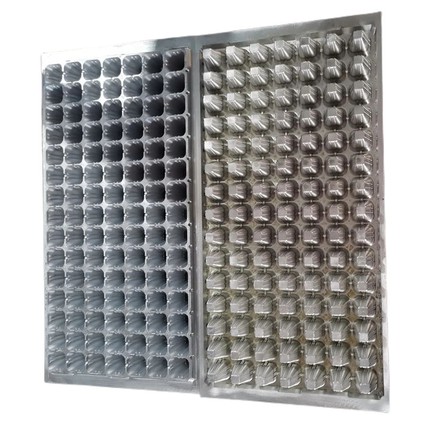
A major design challenge is predicting and compensating for shrinkage. Pulp products shrink during drying, and the rate of shrinkage can vary unpredictably across different parts of the geometry. This complicates dimensional control and mold sizing.
Forming molds are often constructed from materials such as polyester filler, epoxy resin, hardening agents, and aluminum. For parts with low dimensional tolerance requirements, molds can be produced by casting. Higher precision applications require machined tools. Male molds are commonly CNC-machined from aluminum. Female molds can be cast from resin using the male tool as a pattern to ensure accuracy.
Some applications require tight external tolerances. Since wet pulp blanks may warp during drying, a shaping mold is often used to calibrate the final geometry. Shaping molds are frequently made from brass, aluminum, or stainless steel. They may include heating elements and typically do not use a mesh screen. Instead, they work by applying pressure to reform the dried part.
In forming mold design, the male tool is dimensioned according to the product's outer shape. The female tool is sized to accommodate the male tool plus the intended material thickness. This ensures proper fit and consistent part quality.