

Turn Fiber Pulp into Practical Packaging Products
Molded pulp packaging machinery gives manufacturers a flexible way to produce fiber-based trays, carriers, cartons, and protective inserts. Prepared pulp is formed on product-specific molds, transferred from the forming surface, and sent to drying and any required finishing stages. By matching the machine and mold to the packaging design, a producer can build capacity for a clear product and market need.
The most useful starting point is a clear packaging product and a practical production goal. When forming, transfer, and downstream handling are planned together, the line can move wet products consistently and provide a straightforward path for future expansion.
Produce More Than One Type of Molded Pulp Packaging
 Beverage PackagingMolded Pulp Cup Carrier
 Produce PackagingMolded Pulp Apple Tray
 Food PackagingMolded Fiber Food Tray
 Takeaway PackagingMolded Pulp Coffee Carrier
Beyond the four applications shown above, matched molds can also support egg packaging, seedling trays, bottle supports, and protective inserts.
Each product places different demands on the mold and forming setup. A deep protective insert is not handled in exactly the same way as a shallow fruit tray, while a cup carrier needs its own cavity arrangement and stacking profile. Product dimensions, wall shape, nesting, surface expectations, and handling after forming all influence the project design.
If several products are planned, begin with the one that will enter production first and add the remaining mold designs in a practical sequence.
From Pulp Preparation to Finished Packaging

The main production stages are:
- Pulp preparation: suitable fiber material is prepared as a consistent slurry.
- Forming: vacuum draws the fibers onto shaped product molds.
- Transfer: the wet products are released or moved from the forming surface.
- Drying: moisture is removed so the product can hold its shape.
- Finishing: hot pressing, trimming, inspection, stacking, or packing can be added when the product requires them.
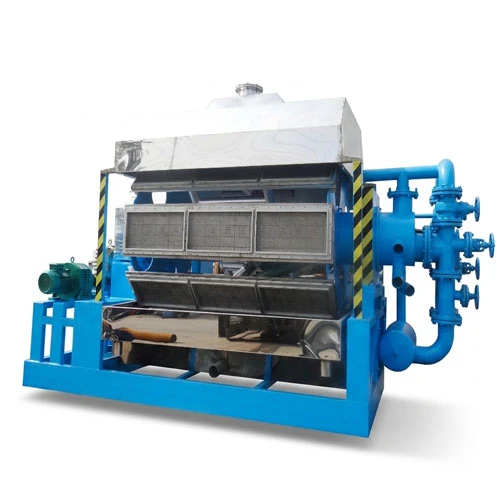
A forming machine covers the molding stage. A complete production line also brings together pulp preparation, vacuum and air supply, water circulation, drying, and downstream handling. Matching the capacity of these stages helps prevent bottlenecks after the wet products leave the forming machine.
A Closer Look at the Forming Section

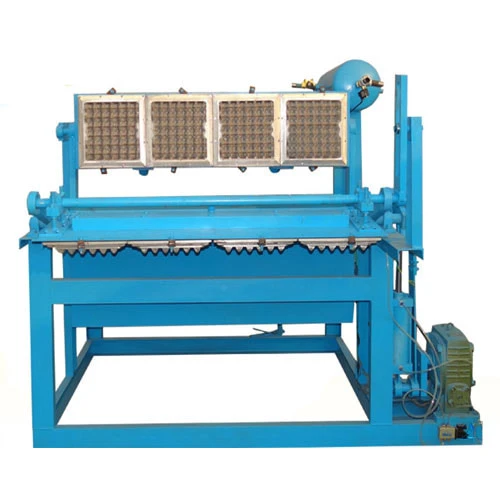
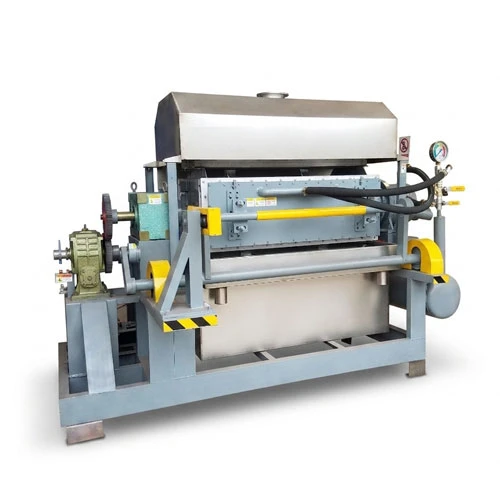
The forming section brings the main working areas together.
Product molds create the required shape and cavity pattern, while the transfer area moves each wet product onward without damaging its form. Vacuum and air connections support fiber pickup and product release, and the frame, drive, and controls coordinate the forming cycle.
Good workshop planning leaves clear access to these working areas for cleaning, inspection, and mold changes. It also provides practical connections to pulp supply and downstream drying. An existing pulping or drying system can often be considered for integration after its capacity, interfaces, and layout are checked.
Molded Pulp Packaging Machinery Specifications
| Models | Output (pieces/hour) | Power (kw) | Mould Quantity |
|---|---|---|---|
| DTF 3×1 | 1000 | 2.2 | 3 |
| DTF 4×1 | 1500 | 2.2 | 4 |
| DT 3×4 | 1800-2300 | 3 | 12 |
| DT 4×4 | 2200-2500 | 3 | 16 |
| DT 3×8 | 3000-4000 | 3 | 24 |
| DT 4×8 | 3500-4500 | 3 | 32 |
| DT 5×8 | 4000-5000 | 4 | 40 |
| DT 6×8 | 6000-7000 | 4 | 48 |
| DT 8×8 | 9000-10000 | 4 | 64 |
| DT 5×12 | 5000-6000 | 4 | 60 |
Choose Capacity for the Product and Factory
Begin with the product you intend to sell and the hourly output needed for your production plan. Compare that target with the mould quantity and output range of each model. The shortlist can then be checked against the planned pulp preparation, drying stage, utilities, and material flow.
Factory planning needs space for:
- Pulp delivery and utility connections
- Wet-product transfer to the drying stage
- Safe operator movement and cleaning access
- Finished-product handling and storage
- Possible future expansion
Connect the Mold to Your Packaging Design
The mold turns a packaging concept into a repeatable product shape. Its cavity layout, depth, wall features, drainage pattern, and release arrangement must suit both the package and the forming equipment. Stacking and nesting also deserve early attention because they affect downstream handling, storage, and transport.
Once a model direction has been chosen, mold development can use the finished-product dimensions and a sample or drawing, together with the required contact points, reinforced areas, openings, logo or surface-detail requirements, stacking and nesting features, pack arrangement, and cavity count.
Protective inserts also need the dimensions of the packed item so the supporting areas can be positioned correctly.

FAQ
Q: How much does molded pulp packaging machinery cost?
A: The budget is shaped by forming capacity, mould quantity, the number of product molds, drying equipment, auxiliary systems, and the required level of automation. Comparing quotations on the same equipment scope gives a more useful result than comparing the forming-machine price alone.
Q: What should I compare when evaluating supplier quotations?
A: Check the stated output basis, mould quantity, included molds, pulp preparation equipment, vacuum and air systems, drying scope, controls, electrical configuration, and the boundaries for installation and commissioning. This prevents two quotations with different scopes from appearing directly comparable.
Q: Can existing pulping or drying equipment be reused?
A: Existing equipment can be assessed for integration by checking its capacity, line height, wet-product transfer method, utility connections, control interface, and available workshop space. These checks show whether the existing equipment can support the selected forming-machine output.
Q: What should I prepare for a custom packaging mold?
A: Prepare a product sample or drawing, overall dimensions, key support points, openings, stacking and nesting requirements, surface details, logo position, and the intended pack arrangement. For protective inserts, include the dimensions of the item that the packaging must hold.
Request a Machine Recommendation
Tell us what packaging product you want to make and your target hourly output. We can help you identify a suitable machine range and the next information needed for your project.
Hot Tags: molded pulp packaging machinery, China molded pulp packaging machinery manufacturers, factory


